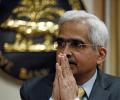
The government has extended the term of Reserve Bank of India Governor Shaktikanta Das by another three years upto December 2024, according to an official order.

'After a long time, we have a governor who is approachable. The RBI's interactions with us are now much better.'

India's foreign exchange reserves have jumped to an all-time high of $651.5 billion as of May 31, Reserve Bank Governor Shaktikanta Das said on Friday. This means the overall kitty has increased by $4.83 billion since the last reported number of $646.673 billion on May 24 this year.

Scenes from polling stations in Mumbai which voted in the Lok Sabha election on Monday, May 20, 2024.
'In this age of competition, we will not survive long if we do not provide quality service to our consumers'

By all available indications, the White House drafted a face-saving note and handed it, ready-made, to Islamabad. Pakistani Prime Minister Shehbaz Sharif was supposed to then post it in the guise of a plea urging Trump to extend the deadline by two weeks 'to allow diplomacy to run its course'. Trump would then graciously accept Pakistan's 'request' and declare a ceasefire. Sharif dutifully posted the message on X. Except that he, or whoever was handling the account, forgot to delete the tell-tale first line visible in the edit history: 'Draft - Pakistan's PM Message on X'. Prem Panicker's must read blog on the Iran War.

'Interest rates will depend on the respective banks depending upon their deposits. We will get a clearer picture from the banks in the coming days,' says Y V Reddy.

Indian economy grew at 7.9 per cent in fourth quarter of 2015-16.

'Growth, liquidity and deposit mobilisation are likely to be discussed during the interaction.'
The government has invited applications for the post of deputy governor of the Reserve Bank of India (RBI) from interested candidates with at least 25 years of experience and below 60 years of age as on January 15, 2025. One of the deputy governors, Michael Patra's current term will end on 15 January. The last date of submission of applications is November 30, 2024.

Subbarao said the flight of dollar being witnessed following the euro zone crisis is a 'natural reaction' when there is an uncertainty.

Microsoft co-founder Bill Gates on Tuesday met Reserve Bank of India Governor Shaktikanta Das and discussed various issues including financial inclusion, payment systems, microfinance and digital lending among others. "Mr.@BillGates visited RBI Mumbai today and held wide ranging discussions with Governor @DasShaktikanta #RBI #rbitoday #rbigovernor #shaktikantadas #BillGates," RBI said in a tweet. Gates Foundation pursues a lot of activity in India including promotion of financial inclusion, health sector and climate change.

Reserve Bank on Tuesday cautioned public against "deepfake" videos of the governor being circulated on social media that claim the launch of or support to some investment schemes by the central bank. In a statement, the RBI cautioned public on "deepfake videos of Top Management" circulated over social media giving financial advice.

India continues to remain an attractive investment destination and rise in repatriation of funds is a sign of a mature market where foreign investors can enter and exit smoothly, Reserve Bank Governor Sanjay Malhotra said on Friday. Gross foreign direct investment (FDI) inflows remained strong, rising by around 14 per cent to $81 billion in 2024-25, from $71.3 billion a year ago.
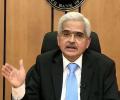
Reserve Bank Governor Shaktikanta Das on Tuesday said the fiscal-monetary coordination was at its best during the last six years even as he thanked Prime Minister Narendra Modi for giving the opportunity to head the monetary authority of the country. Das, in a series of posts on X, on his last day of his six-year term as RBI Governor, also thanked the Finance Minister, various stakeholders and his colleagues at the central bank.
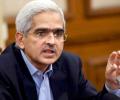
The December meeting of the Reserve Bank of India's (RBI's) six-member Monetary Policy Committee (MPC) will start on Wednesday even as there is no clarity on whether Governor Shaktikanta Das, the chair of the panel, will continue in office after his term ends next week. The outcome of the meeting will be announced on Friday by Das at 10 in the morning.

The transmission of the February and April rate cuts is now complete, validating the central bank's monetary stance and contributing to a revival in credit growth, said Reserve Bank of India (RBI) Governor Sanjay Malhotra on Friday. "We now have preliminary figures for June credit rates, and we find that for new loans, the rates are lower by at least 50 basis points (bps)... within two months of our 50-bp cut, we are in June, and the whole of the monetary policy transmission has happened.

The Reserve Bank of India (RBI) is in no rush to launch the central bank digital currency (CBDC) nationwide, as its most promising use case - cross-border payments - depends on other countries rolling out their own CBDCs simultaneously for the system to work effectively. That said, the CBDC pilot is progressing well, with the user base in India expanding to about seven million, said RBI Deputy Governor T Rabi Sankar.

Rashtrapati Bhavan has introduced a new initiative, the E-Upahaar auction, to monetise valuable assets for a social cause, in alignment with a broader governmental policy, championed by Prime Minister Narendra Modi, of auctioning gifts received by dignitaries to fund welfare programmes.
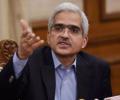
The Reserve Bank of India Governor Shaktikanta Das on Monday said that the "momentum of inflation is on a downward slope" and the central bank would continue to strike a delicate balance between the need to contain price rise and ensure economic growth. The Reserve Bank's inflation projections, Das said, are "robust" but contingent on downside and upside risks associated with the movement of global crude oil prices. The RBI takes into account a particular range within which crude prices are expected to fluctuate considering all the factors that can be anticipated and that can be sort of foreseen as of today, he said.

In 2023-2024, 95 scheduled commercial banks received over 10 million complaints from their customers. The process of KYC at many banks has become 'HYC' -- harass your customer, points out Tamal Bandyopadhyay.

Private sector bank board members have urged the Reserve Bank of India (RBI) top brass to consider workload management of the boards as they feel there are too many issues that go to the boards for approval and the situation becomes unmanageable at times. The views were conveyed to the regulator on Monday in a conference of directors of private sector bank boards on the theme "Transformative Governance Through Sound Boards". RBI governor Shaktikanta Das, deputy governors Swaminathan J and M Rajeshwar Rao, and other senior officials of the central bank participated in the conference.

P K Mishra, a retired IAS officer of the Gujarat cadre, is currently serving as the principal secretary to the prime minister.

Sanjay Malhotra takes charge as the 26th RBI governor at a time when headline retail inflation has shot up to 6.2%.

The Securities and Exchange Board of India (Sebi) has planned a slew of further relaxations to facilitate easier registrations of foreign portfolio investors (FPIs), including a common know-your-client (KYC) and smoother documentation through India digital signature.
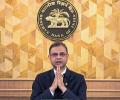
'A repo cut will be very good for the market as it will mean that everything is being done to spur growth in these uncertain times.'

'I think today RBI supervision is much sharper than what it was earlier.'
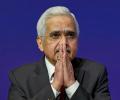
Outgoing Reserve Bank Governor Shaktikanta Das said on Tuesday that restoring inflation-growth balance is the most important task ahead of the central bank. Addressing a press conference on his last day as the central bank chief, Das said his successor will have to navigate the changing world order, effectively deal with cyber threats, and focus on harnessing new technologies.

Subbarao said in terms of the risk to growth inflation outlook, the first would depend on global recovery and if it fails, could have an impact for India.
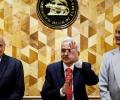
'The central bank has highlighted that the slowdown in growth has been limited to a few sectors and overall growth is expected to pick up in the second half of the year.'
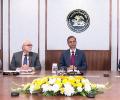
'We never waste a crisis. There will be learning and the supervisory tools will get better with each episode.'

The Reserve Bank of India on Friday decided to keep the policy rate unchanged for the 11th time in a row but sharply lowered the GDP growth forecast to 6.6 per cent for the current fiscal, as against earlier projection of 7.2 per cent. The Reserve Bank of India (RBI) maintained the status quo on interest rate despite July-September quarter GDP growth falling to 7-quarter low of 5.4 per cent, as against its own projection of 7 per cent.
The RBI is likely to reduce the key interest rate by 25 basis points this week after keeping it on hold for two years, complementing the Union Budget initiatives to push consumption-led demand, though the sliding rupee continues to be a concern. As the retail inflation has remained within the Reserve Bank's comfort zone (less than 6 per cent) for most of the year, the central bank can take rate action to boost growth hit by sluggish consumption, opined experts.

India's foreign exchange reserves increased to $604 billion as on December 1, surpassing the $600 billion mark after a gap of about four months. The forex reserves were last above the $600 billion mark on August 11 this year. "India's foreign exchange reserves stood at $604 billion as on December 1, 2023.

Several executives argue that UPI has the potential to grow tenfold, but warn that the absence of a monetisation model risks stagnating the real-time payments system, which has been recording all-time-high transaction volumes every year.
While participants in the domestic financial market are expecting a 25 basis-point policy repo rate cut in the December meeting of the Monetary Policy Committee (MPC) of the Reserve Bank of India (RBI), economists remain torn between a reduction in rate cut and a pause.
Since February 2025, the RBI has reduced the policy rate by 100 basis points. In its previous policy review in April, it had also trimmed the repo rate by 25 basis points to 6 per cent.

Reserve Bank of India (RBI) Governor Shaktikanta Das said on Friday said the central bank has developed an innovative artificial intelligence and machine learning (AI/ML) based model MuleHunter.ai to address the growing issue of mule bank accounts that are often used for committing financial fraud. Developed by the Reserve Bank Innovation Hub, the new initiative is piloted with two public sector banks.

Reserve Bank Governor Sanjay Malhotra on Friday said the exchange rate policy has remained consistent over the years and the central bank does not target any 'specific level or band' of the rupee, which slipped to an all-time low of 87.59 to a US dollar. On Thursday, the rupee plunged 16 paise to close at a record low of 87.59 against the American currency. "I would like to mention here that the Reserve Bank's exchange rate policy has remained consistent over the years.
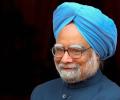
Former Prime Minister Manmohan Singh's 1991 budget unshackled India's economy, significantly enhancing the economic prospects for hundreds of millions of Indians, first deputy managing director of the International Monetary Fund (IMF) Gita Gopinath said on Friday.
